Tuesday, May 22, 2018

More Spring Wild Flowers from Northern Montgomery County

Here are some more wild flowers. I just can't seem to get enough of them. Perhaps you feel the same?
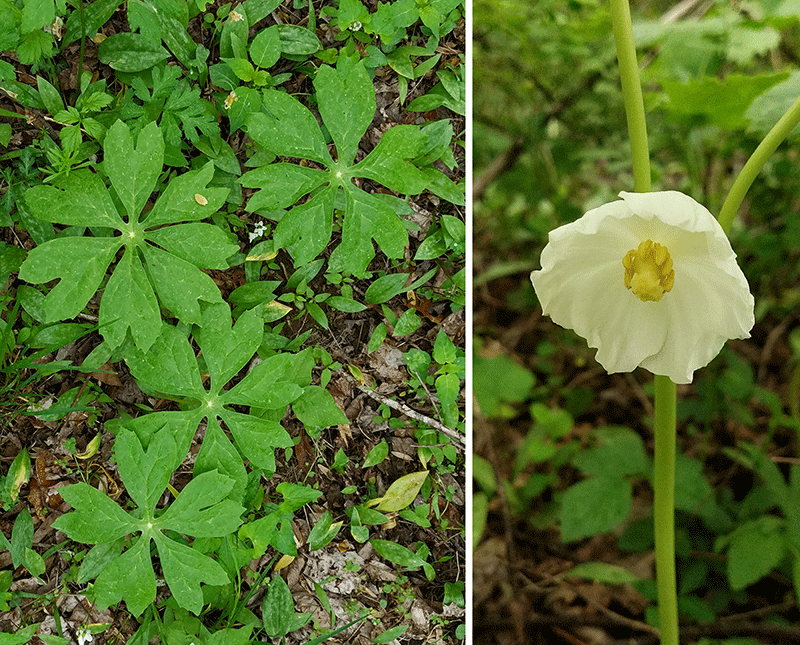
Mayapple (Podophyllum peltatum) (Berberidaceae: Barberry Family) Native (Patuxent River State Park, May 5, 2018). This is probably the most recognizable herbaceous plant of the forests in eastern North America. The plant may appear and flower in May but the "apple" doesn't appear until June. The flower emerges from the stem and is typically hidden by the parasol-like leaves. When ripe, the fruit is yellow rather than apple red and is apparently edible and tastes of lemon. However, one must take care with this plant. It has a potent toxin called phyllopodotoxin that has a lot of folk and medical uses.  One of the main effects of the toxin is the suppression of cell division, primarily breaking DNA and inhibiting enzymes associated with DNA replication. Derivatives of the toxin are used in chemotherapy for various cancers. Asian Podophyllum hexandrum has been over-harvested in the wild for their podophyllotoxin. Attention is now shifting the the American species. Hopefully, we will be wiser in our use of these plants.
----------
"The land whereon thou liest, to thee will I give it, and to thy seed.
Yahweh to Jacob, Genesis 28

Jacob's ladder (Polemonium reptans) (Polemoniaceae: Phlox Family) Native (Patuxent River State Park, May 5, 2018). This is my first encounter with this plant. It likes rich, moist forest soils, typically near streams, and this describes the place I found these to a tee. The flowers were not fully open. It's common name refers to a passage from Genesis where Jacob, pausing in his escape from his brother Esau (of crossword-puzzle fame), dreams of a ladder between Earth and Heaven on which angels ascend and descend. Interpretations vary. Anyway, the alternating pinnate leaves reminded someone of a ladder, I guess, with roots in the earth and a heavenly cluster of blue flowers on top. There is also a 1990 movie of the same name that I remember as being pretty good, although confusing and sad. My recollection is that it was sort of an updated, complexified, cinematic version of Ambrose Bierce's short story An Occurrence at Owl Creek Bridge. [As an aside ... even further aside ... I think that Bierce is a very underappreciated writer of weird and horror fiction, with An Occurrence... being the one most fit for High School AmLit anthologies. However, his short story Chickamauga is one of the most affecting horror stories I've read and thus unsuitable for public schools.] So, what has this got to do with Maryland, nature or flowers? Nothing really, but it's my blog and I will drone on about stuff as I please. So, there!
 ----------
Virginia Pennywort (Obolaria virginianica) (Gentianaceae: Gentian Family) Native (Rachel Carson Conservation Park: May 7, 2017). These are peculiar little plants that pop up in moist forest soils. They look like they could be the ornamental shrubs in the yard of a doll's house. The flowers and leaves are tightly compact (at least early on). The flowers are white to pink and the leaves are green to purplish. The leaves are small and round and so resemble a penny.
----------

Wild Geranium (Geranium maculatum) (Geraniaceae: Geranium Family) Native. One of 10 species of wild geraniums that one might encounter in Maryland, according to the Maryland Biodiversity Project.This a fairly common sight in the spring and early-summer woods of central Maryland: lilac-colored flowers projecting up to 2 feet with large palmate, deeply dissected leaves. If you can't get to the woods, there are possibilities for observing some kind of wild geranium closer to home ... in your lawn or garden, for example.
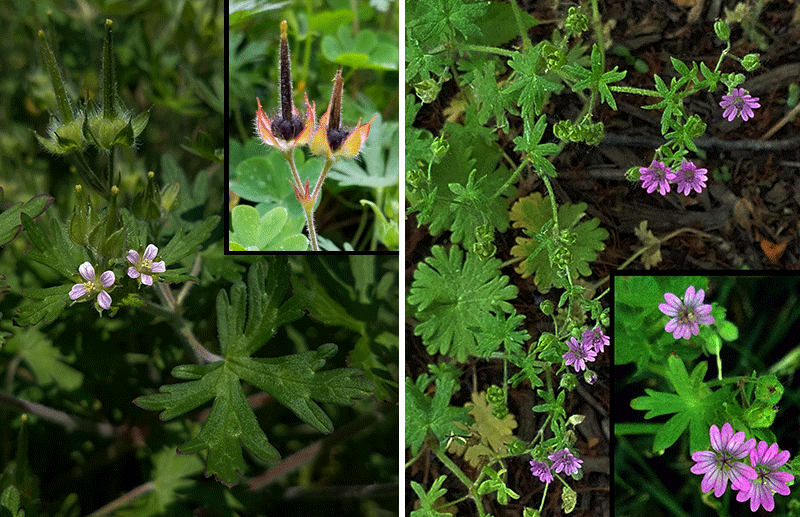
Left: Carolina Cranesbill or Carolina Geranium (Geranium carolinianum) Native (UMD Campus: May 15, 2018). Small plant with unimpressive pint-to-white flowers and three- or five-lobed palmate leaves, similar to those of G. maculata. Inset: ripening fruit of the same plant (May 18). Right: Doves-foot Cranesbill (Germanium molle). Introduced from Mediterranean Region (UMD: 5-15-18). These have tiny pink flowers with each petal deeply notched, thus giving the impression of having 10 petals. I guess the common name refers to the three-toed lobes that line the edge of the leaf, but a Google Image search of "dove foot" makes me think that someone was NWI ... naming while intoxicated.

The term "cranesbill" refers to the shape of the fruit, which looks like the head of a crane ... The NWI guy, again? ... The "head" is at the base and is composed of five seed capsules (mericarps), each with one seed. The "beak" projects upward and is composed of five long projections (awns) that are attached to each other along their margins. The "beak" is actually a catapult-like device that explosively propels the seeds once has dried to a critical point. It sort of works like the capsule of a touch-me-not or jewelweed.

There are three different approaches to "explosive" seed dispersal in the Geraniaceae. In all species depicted above, the "explosion " launches the seeds alone over 1.5 feet. There can be secondary dispersals by ants or water (the seeds of G. maculata are denser than water and tend to stay where they land, but those of G. molle are less dense and are probably transported by rain run-off.) Another mechanism launches the capsules with the seeds in them. The last mechanism launches all of the components of each of the five parts. This occurs in Red-stemmed Storksbill (Erodium cicutarium), a non-native plant also found in Maryland. When the "bill" dries, the half of the awn closest to the mericarp coils into a cork-screw shape. The seed-mericarp-awn apparatus (below) sits on the soil until it rains, when the awn soaks up water and begins to uncoil. This process essentially drills the mericarp into the soil, and the mericarp has slanted projections that keep it from backing out again. Even "weeds" can be cool. For more details follow this link.

http://idtools.org/id/table_grape/weed-tool/key/GrapeSeedKey/Media/Images/Entity_key_images/Ero_cicC139-09.jpg
----------
Rue Anemone (Thalictrum thalictroides) (Ranunculaceae: Buttercup Family) Native.The clover-like leaves that form a sort of understory to the anemones are those of Violet Woodsorrel (Oxalis violacea) (Oxalidaceae: Woodsorrel Family) Native.  Rachel Carson Conservation Park: May 11, 2018
----------
Showy Orchid (Galearis spectabilis) (Orchidaceae: Orchid Family) Native. Rachel Carson Conservation Park (April 29, 2017). These orchids occur in mooist deciduous forests in much of eastern North American, usually near streams or ponds. Each plant has two large and rather thick basal leaves that embrace a central stalk that bears several flowers. So, there are about six plants in this cluster. Each flower consists of a pink to purple "helmet" and a white "beard". The helmet is composed of three sepals on the outside and two petals on the inside. The beard is one petal and has a nectary at the top.  Bumble bees are a primary pollinator of this species. They land on the white beard and drink the nectar.

Sunday, April 29, 2018

Spring Wildflowers (etc.) from Patuxent River State Park

It seems that spring has finally arrived in central Maryland. So, I ventured out this past weekend to see what was blooming in the northwestern part of Patuxent River State Park in northern Montgomery County. Here is some of what I saw. It was a very pleasant day and I felt reinvigorated.

Yellow trout lily (Erythronium americanum) (Liliaceae: Lily Family) Native. Commonly encountered in relatively moist woodland soils, frequently near streams. They can occur in dense aggregations, where most plants are simply small green leaves that don't ever seem to send up flowers.  There is also a species with a white flower, Erythronium albidium, but I have yet to encounter this one. The name "trout" lily is said to come from the splotchy color pattern on the leaves that resembles the color of some trout.  OK...whatever.
--------------------------------------------------------------

Bellworts (Uvularia)
There are five species of bellworts in the world, all of which occur in the eastern and southern United States. Four species occur in Maryland, and the two pictured here are the ones most likely to be encountered in the central part of the state. They belong to the family Colchicaceae (Meadow Saffron Family), which is closely related to the Liliaceae. The family has a nearly world-wide distribution but Uvularia is the only genus native to the U.S.

Sessile-leaved bellwort (Uvularia sessilifolia) Native. The species gets its name from its "sessile" leaves, meaning the leaves arise directly from the stem rather than by a stalk (petiole). Two specimens from Patuxent River State Park (4/28/18)

Perfoliate bellwort (Uvularia perfoliata) Native. In this species, the stem passes through the leaf. Specimen from Rachel Carson Conservation Park (4/29/17)
 Not bellworts, but in the same family...
Colchicum sp. Non-native ornamental, not invasive. There are several species and varieties of meadow saffron that are used as ornamental plants. Most of these bloom in the autumn, but some bloom in the spring and are called "crocuses". However, these are neither true crocuses nor true saffron. Anyway, I saw a lawn full of these in Damascus, MD last year and stopped to take some pictures with my first (and so far only) smart phone. These were only the second and third photos I had taken using the phone (virtually all of the photos on this blog are taken with a phone).  The people driving by kept slowing down to see what I was doing and the people behind them would honk at them to get moving again.  I guess a guy taking pictures of flowers in a lawn can be a big deal in a small town.
--------------------------------------------------------------
Small woodland evergreen plants. Left: Downy rattlesnake plantain (Goodyera pubescens) (Orchidaceae: Orchid Family). Native. A native orchid characterized by a low cluster of dark green leaves with distinctive reticulated pattern of veins. We will have to wait until June to see the long stalk terminating in an elongate cluster of compact white flowers. Right: Spotted wintergreen (Chimaphila maculata) (Ericaceae: Heath Family) Native. Tapering dark green leaves with sparsely toothed margins and a broad white midvein with small white lateral veins. This specimen has a stalked seed capsule from last year. Patuxent River State Park (4/28/18)
--------------------------------------------------------------
 Every garden has its serpent
Eastern garter snake (Thamnophis sirtalis) (Family Colubridae). Native. Patuxent River State Park (4/28/18)
--------------------------------------------------------------

Narrow toothwort (Cardamine angustata) (Family Brassicaceae: Mustard Family) Native. There are several species of toothworts in Maryland, and several other congeners called "bittercresses." Flowers each with four pink to white petals clustering near the end of long, erect stem. There are two kinds of leaves: broad basal leaves, each with three deeply lobed leaflets, and smaller, thin leaves higher on the stem. Specimens like those on the left were found growing on a dry woodland slope, and specimens like those on the right were growing in a less-wooded flood plain. Patuxent River State Park (4/28/18). 
--------------------------------------------------------------

Yellow Corydalis or yellow fumewort (Corydalis flavula) (Family Papaveraceae: Poppy Family) Native.  I found large stands of this interesting plant on wooded slopes in Patuxent River State Park. To me, the leaves look like those of parsley. The yellow flowers are tiny, but the four petals have a complicated arrangement that kind of resemble jewelweed (touch-me-nots). But these are just superficial similarities. They are annuals and must germinate very early in the season to reach maturity so quickly. (4/28/18)

 WARNING!
Yellow corydalis is a lovely and harmless native plant. However, a close East Asian relative, the incised fumewort (Corydalis incisa), is an emerging invasive species. Its leaves are similar to those of yellow corydalis but the flowers are more tubular and purplish, not yellow. Its invasive potential was revealed by the discovery of 39 populations in the Bronx River Preservation Area in New York, but it has since been reported in several widely separated locations, including Montgomery County, Maryland.  It has the potential to spread throughout the eastern U.S. For more information about this plant, see this Weed Risk Assessment from the Maryland Department of Agriculture.
--------------------------------------------------------------

Clubmosses (Division Lycopodiophyta, Family Lycopodiaceae). The clubmosses diverged very early in the evolution of land plants and still have the look of a "moss" about them. There are about 13 species in Maryland, with two of the most common depicted here. Left: Flat-branched tree clubmoss (Dendrolycopodium obscurum). Native. Right: Southern ground cedar (Diphasiastrum digitatum). Native. Forest floor, Patuxent River State Park (4/28/18)
--------------------------------------------------------------

Left: Dwarf ginseng (Panax trifolium) (Araliaceae: Ginseng Family). Native. A small, common relative of the larger and much rarer American ginseng (Panax quinquefolius). American ginseng is increasingly rare due to habitat degradation and overharvesting for the Asian market. Right: Virginia spring beauty (Claytonia virginica) (Montiaceae) Native. This is one of the most common of the spring wild flowers in our area. It was in bloom everywhere in Patuxent River State Park last weekend. The blooms are highly variable in color, ranging from white to pink, with or without pink radiating stripes. Each flower usually has five petals, but the one shown above has seven.


Sunday, February 18, 2018

A Presidents' Day Diversion: A Photo Travelogue of James Buchanan's Wheatland

 
Seeking knowledge and adventure, we traveled to Wheatland, the home of James Buchanan, 15th President of the United States. On paper, he seemed highly qualified for the job; he had been Ambassador to England and Russia, a US Representative, Senator and Secretary of State. Yet, he turned out to be a rather disappointing president. (It's hard to imagine the American people could make such a mistake!). So, off we went to Lancaster, PA!


This photo makes our visit official.
They put out the welcome mat for us.
 
The front door of Wheatland. It's maintained just as it was in the 1860s!

The back door of Wheatland.

Buchanan was always concerned about safety.
He was a lawyer, you know.

He was not much into gardening.

I imagined the President stacking these bricks.


He was ahead of his time in some ways.

Buchanan's Mutt Mitt is still in use today!


We were promised a frog pond in the pamphlet, but there were no frogs and no ponds. I settled for this odd ice house/smoke house combo.

Traffic in front of Wheatland. Cool convertible, dude.


The President was imaginative in parking his carriage.

The number of holes is proportionate to wealth and prestige. We didn't realize these were non-functional. Oopsie!
The gift shop had these tiny coffins. I thought there might be bits of Buchanan in them but was afraid to look.

Thursday, January 4, 2018

Nature in Fragments: Vixen Screaming, Butt Rot Weeping and A Winter Centipede Mystery

Greetings, readers. It is I, A Maryland Naturalist, writing to you from the Information Technology Center of the AMN compound deep in the heart of Maryland. Today we offer a Whitman's Sampler from our vast archives. Please consume each chosen item completely. Do not return nibbled remainders to the blog. That behavior is beyond impolite; it leaves an unwholesome and sticky mess for those who visit after you. Be considerate.

The Vixen's Scream
There are a couple red foxes living near us, and it's always a treat to see them. They usually seem to be in a hurry to get somewhere, but it's hard to know what's going in those little red heads. Our house is built on a slope that descends to a stream. We have a great view of the woods on the opposite bank and the animals that traverse it. One day I saw a small herd of deer running through the woods paralleling the stream and a fox on our side keeping pace with them. The fox seemed to be having a great time. I wonder, did he think he was in a race? Was he lonely and imagining he was part of the herd? Did he have delusions of predatory grandeur? Mysterious creatures.

This beautiful fox was visiting our bird feeder, more for the seed than for the birds it seems. Janet, m'lady, saw him and watched him from the deck that overlooks the feeder. He looked up and she captured this photo. The fox was not overly concerned by her presence and continued his seed eating.


We hear foxes more than we see them. They make a variety of noises ... barks, howls and screams... usually at night. The sounds are rather high pitched and could be pretty eerie if you didn't know what they were. The vocalization we hear most often is called the vixen's scream. It seems to be a general purpose social call used frequently by vixens during the mating season but by both sexes for territorial or social encounters all year. One fox seemed particularly head up about something on the evening of November 24, so I recorded it. Click on the image of the trees to hear it.

Click here to listen to the vixen's scream.


Yet Another Case of Weeping Butt Rot
The polypores are a large group of basidiomycete fungi that almost always grow on living or newly dead wood. They include many of the fungi that produce shelves, brackets and conks. The name polypore refers to the numerous perforations on the fruiting body.

Upper left: Various stages of conks of Inonotus dryadeus, the Oak Butt Rot Fungus, Weeping Conk or Weeping Polypore. Upper right and lower: A young conk "weeping" a viscous amber fluid.
I mentioned the butt rot fungus, Inonotus dryadeus, in an earlier post (Pick Your Poison, 8/31/17), noting that the appearance of conks around a tree indicates that the structural integrity of the tree is probably compromised and that it may be prone to tipping over in high winds or during excessive administrative bloviation. I couldn't find a young conk for my first post, so didn't illustrate why it's called the weeping polypore. However, I later found one on the University of Maryland campus (see pictures above).  Note the numerous pores with viscous amber fluid oozing from them. I haven't found an explanation for the weeping, although it could be experiencing remorse for killing a beautiful old tree. Actually, I suspect this is the fungal version of crocodile tears.

The conks on the upper left are of different ages. The very dark ones are old and weathered and just don't understand the young whipper snappers, who are constantly whining about something or other. Snow flakes! The young ones think that the old ones are dried up and useless. Turns out that the young ones are wrong about the old ones. I recently ran across a research paper in ACS Biomaterials Science & Engineering in which the author shows that the old, dark, dried-up conk of I. dryadeus is remarkably good at pulling petroleum, certain insecticides and other pollutants from water ... like a selective sponge. This ability is apparently related to both the physical structure and chemical composition of the conk. Once the fungus is saturated, it can be dried out and burned. So, it's possible that butt rot conks could be used in sopping up oil spills. You just never know.

A Winter Centipede Mystery
No sane entomologist would look for bugs in the depths of winter. This is where I have an advantage. During a March about a decade ago, I was knocking around in a woodlot in northern Montgomery County looking for snow scorpionflies. They were there a few weeks before, but I was having no luck this time, probably too late in the season. So, on a lark, I decided to turn some logs. Upon rolling one particularly rotten one, I glimpsed several large, red centipedes escaping at high speed into the surrounding frost-coated leaf litter. This was remarkable for a couple reasons. Centipedes aren't generally known for their winter high jinks and, even at a pleasant temperature, they don't tend to hang out in groups. I guessed that this was probably an undocumented behavior of Scolopocryptops sexspinosus, a rather large (up to 8 cm or 3 inches) orange-red woodland centipede that's found in much of the eastern and central U.S. during late summer and fall. Still, something seemed "off". They just didn't seem right... not the right time of year, not orange enough, not sure.
Scolopocryptops sexspinosus collected in October 2017 from Patuxent River State Park in Montgomery County.

Later I learned of a related centipede, Scolopocryptops peregrinator, another Maryland native. It's been collected only a few times, but the known specimens were found in late fall and early spring. Its existence wasn't officially recognized by science until the early 1950s from populations near Charlottesville, Virginia and Woodside, Maryland. Could this be what I saw running around in the cold?

This explanation seems unlikely at first blush. Scolopocryptops peregrinator is described as being about half the length of S. sexspinosus and yellow rather than orange-red. A couple weeks ago, I found a S. peregrinator in my backyard under a log I had used as a chopping block and several a week later. They all match the technical description. However, my myriapodological colleague Dr. Rowland Shelley has surmised that this centipede may be active during the winter, when biologists tend to stay indoors, and so they are rarely collected rather than being truly rare. Anyway, given that S. peregrinator is a little yellow fellow, it stilled seemed likely that the big red centipedes I saw 10 years ago were S. sexspinosus.

A specimen of Scolopocryptops peregrinator collected in early December 2017. This is probably the first photo of a live specimen. Thanks to Anthony Nearman for taking the picture as I attempted to wrangle the animal into a photogenic position on the back of my extremely dry hand. Centipedes don't like to have their pictures taken.


Lately, the plot has thickened. I was looking through a collection of centipedes and other critters caught in a series of year-round pitfall traps from the infamous Leakin Park of Baltimore. The preservation was not great (colors were bleached out), but the samples contain S. sexspinosus as well as a different and equally large species that looks like a giant S. peregrinator. So, is this a new species or, perhaps, a population of giants? My best guess at the moment is that the known specimens of S. peregrinator are actually juveniles. If they turn from yellow to red as they mature, this could explain my observation a decade ago and the existence of big "unknown" centipedes in Baltimore. It also means that the adult has never been described. [And, no, I don't think the size of the centipedes is related to unusual food sources in Leakin Park.]

To make the season a little more interesting, I've made a resolution to solve this winter centipede mystery this year. Stay tuned...

Thursday, December 7, 2017

Photographing Orbs


I was hanging around in a leather shop in Laurel. If you must know, I was dropping off a damaged strap, bridle, girth or something ... for a horse.  The owner was showing everybody photos of orbs he had taken near Gettysburg one night. According to him, orbs are the floating spirit energies of dead soldiers or other existentially challenged folks, not the flash or other light reflecting from dust or bugs. To be fair, I suppose that both could be true: aerial flotsam could contain the spirits of dead soldiers; cavalry soldiers could be riding the dust. (How many orb soldiers can fit on a dust speck?) Anyway, I have a question: if the orb hunters really thought that orbs were the spirits of dead soldiers, why would they treat them with such disrespect, interrupting their ghostly business with blinding flashes and inevitable hooting and hollering? Thank you for your service!

Look at this YouTube video for an explanation of what orbs really are.
Now you know
I photographed different orbs: the orb webs of spiders. Orb webs have threads radiating from a central point that support a sticky spiral thread that captures flying insects. Until very recently, arachnologists thought that orb webs evolved once in a group of spiders aptly called the Orbiculariae. However, it now appears that the orb web is more ancient than we thought and that most nontarantula-like spiders had ancestors with orb webs (Paper). Orb webs are great for capturing flying insects, but not always so good for crawling insects and they may be energetically expensive to make. For whatever reason, there's been a tendency for spiders to switch to sheet webs or cob webs or to dump the whole web thing altogether.


Superfamily Araneoidea
Family Araneidae: Common Orbweavers
Araneid orbweavers are very diverse and abundant, and this diversity increases to a crescendo in late summer and early fall. They generally build vertical orb webs: spoke-like radial strands attaching to a frame lines and bearing a spiral with tiny gluey droplets.

Left: Black and Yellow Garden Spider, Argiope aurantia. Charlotte, a recent mascot of the Dept of Entomology, University of Maryland. RIP. Center: Banded Garden Spider, Argiope trifasciata, upper surface. Right: A. trifasciata, ventral surface.

The genus Argiope has about 80 species distributed throughout the world, including five in the contiguous 48 states and two in Maryland. They tend to be large spiders (the females, anyway) and spin large webs that are usually and variably decorated with a central pattern of silken bands called a stabilimentum, a structure produced by many different orbweavers. Arachnologists have researched and debated the function of stabilimenta for decades and Argiope species, with their many variations in design, have been frequent experimental subjects. Stabilimenta may serve as a signal to birds to prevent them from flying into and destroying the web, as a way of breaking up the outline of the spider as a sort of camouflage, and attracting insects with reflected UV light. These functions may vary between species and perhaps could even differ within a species depending on the ecological or behavioral context.

Left: A newish web at the University of Maryland in some ornamental shrubs. Right: An older web in in rural southern Frederick County on a wooden fence.
These are Cyclosa turbinata, the Humped Trashline Orbweaver, which is a small and fairly common orbweaver. A second trashline spider, Cyclosa conica, also occurs in Maryland. The “trashline” is a vertical row of silk-packaged remains of previous meals, egg sacs as well as the spider itself.  The spider occupies the center of the orb near the center of the trashline. This is a kind of camouflage and, unlike many other araneids that will run away or take other evasive action upon detecting an approaching person, Cyclosa will tend to just hang in there. I suppose this gives some weight to the stabilimentum as "hiding place" idea.

Left: Spined Micrathena, Micrathena gracilis. Center: White Micrathena, Micrathena mitrata. Right: Arrowhead Spider, Verrucosa arenata
I found these three spiders in my backyard one day in September. Micrathena is a genus of small to medium-sized orbweavers that make their webs at about the level of an adult human's face. There are times during the summer when you can't walk through the woods around here without getting a face full of their webs. The near-vertical webs are hard to see, even when you are looking out for them. The spiders will generally try to run off the web to a supporting branch or twig as you approach, but it often gets wrapped around your head or shoulders along with the web, anyway. They don't bite and their abdomen is so hardened that you can pick them up with your fingers without hurting them and place them on a twig or leaf to resume their spidery business. There are three species in Maryland, the two pictured above and the Arrowshaped Micrathena, M. sagittata.

The third spider, Verrucosa arenata, is larger than Micrathena. Sometimes the triangular portion on its back is white, sometimes yellow. The species' main claim to arachnological fame is that it's one of the few orbweavers that rests face-up in the web rather than face down. Why?  I doubt anybody knows.
Two of many color variations of the common tree or barn spider, Neoscona crucifera
Spiders in the genus Neoscona are often called Spotted Orbweavers, apparently due to the pair of light spots on the underside of their bellies, as in the first image of this blog. The "crucifera" part of N. crucifera means "cross bearing", because the top of the abdomen often has a mid-longitudinal line and a transverse line at the front end that together create a cross. Neither of the specimens depicted here show an obvious cross, although you can kind of see it in the one depicted on the right. This is a very common spider in summer and autumn in Maryland and throughout much of the eastern U.S. They build relatively large webs, up to 2 feet across, in trees, bushes, fences, railings, etc. They are largely nocturnal, although they will hang out in the middle of their webs for a while during the day if it's cloudy or shady, but they eventually take the spiral of their web down by eating it and then rebuild it in the evening.

Tetragnathidae: Long-jawed Orbweavers
Like the araneid orbweavers, the tetragnathids build webs with a gluey spiral, but the webs are usually oriented in a more horizontal plane. There aren't as many tetragnathid species in the eastern U.S. as there are araneids, but some species are common. One of the most recognizable genera is Tetragnatha, which have long legs, long abdomens and long chelicerae or "jaws". I didn't happen to run across any this summer, but you can check them out at either the Maryland Biodiversity Project or Bug Guide.

Orchard Spider, Leucauge venusta. Note spirit orbs caught in the orb web on the left.
Leucauge venusta is one of the most common orbweavers in the eastern states. It builds a near-horizontal web with an open hub in low bushes and shrubs. It is easy to recognized by greenish legs and an abdomen patterned with silvery white, black, yellow and green, sometimes with an orange mark on the under surface.

Superfamily Deinopoidea
The nontarantula-like spiders (that is, the spiders we are most likely to encounter in eastern North America) were once classified into two groups, cribellate and ecribellate, which differ in the kind of silk they produce. The cribellate spiders have a special "spinning plate" near the spinnerets called a cribellum that produces lots of fine silken strands, and the fourth leg has a special comb, the calamistrum, that is used to manipulate this silk. The cribellate silk ensnares insects by mechanical entanglement rather than by a chemical sticky glue. Back in the day, arachnologists figured that both cribellate and ecribellate groups had orb weavers, sheet weavers, ground spiders, tube makers, etc. and that this was an example of parallel evolution. Later, it was shown that the cribellate silk was actually the ancestral kind of silk for all these spiders and that lots of spiders lost it, resulting in a complicated mix of cribellate and ecribellate spiders. So, there are cribellate spiders that look like our familiar true ecribellate wolf spiders and they are actually closely related.

The superfamily gets its name from the genus Deinopis (Family Deinopidae), which means "terrible or fearsome eyes". Their common name is ogre-faced or gladiator spider, and they live in tropical and subtropical areas. They build a web of mostly cribellate silk that they hold with the first two leg pairs, while clinging to a silken support with their other legs. They use the web like a net to capture crawling or flying insects. (See video)  Obviously, they need good eyes to accomplish this.

 Family Uloboridae: Hackleband Orbweavers
Octonoba sinensis
The uloborids are the cribellate orbweavers. There are very few species of uloborids in eastern North America, although they have a variety of web designs. For example, Hyptiotes, the triangle spider, builds a triangular web that looks like a pizza slice of an orb web, but the pointy end is held taught by the spider via a single long thread. The spider releases the thread when prey hits the triangle and the web collapses on the insect. (see Video). 

The uloborid shown here, Octonoba sinesis, builds a fairly typical horizontal orb with a doily-like stabilimentum. The species appears to have been introduced accidentally into the United States from East Asia. I found these living the vertical shaft of a grated outside drain on a horse stable in Frederick Co., Maryland.  The high density of webs is probably made possible by the continual emergence of flies from the drain. To me, they looked like galaxies suspended in the smelly void of space. (In space, no one can hear you wretch.)