Sunday, February 18, 2018

A Presidents' Day Diversion: A Photo Travelogue of James Buchanan's Wheatland

 
Seeking knowledge and adventure, we traveled to Wheatland, the home of James Buchanan, 15th President of the United States. On paper, he seemed highly qualified for the job; he had been Ambassador to England and Russia, a US Representative, Senator and Secretary of State. Yet, he turned out to be a rather disappointing president. (It's hard to imagine the American people could make such a mistake!). So, off we went to Lancaster, PA!


This photo makes our visit official.
They put out the welcome mat for us.
 
The front door of Wheatland. It's maintained just as it was in the 1860s!

The back door of Wheatland.

Buchanan was always concerned about safety.
He was a lawyer, you know.

He was not much into gardening.

I imagined the President stacking these bricks.


He was ahead of his time in some ways.

Buchanan's Mutt Mitt is still in use today!


We were promised a frog pond in the pamphlet, but there were no frogs and no ponds. I settled for this odd ice house/smoke house combo.

Traffic in front of Wheatland. Cool convertible, dude.


The President was imaginative in parking his carriage.

The number of holes is proportionate to wealth and prestige. We didn't realize these were non-functional. Oopsie!
The gift shop had these tiny coffins. I thought there might be bits of Buchanan in them but was afraid to look.

Thursday, January 4, 2018

Nature in Fragments: Vixen Screaming, Butt Rot Weeping and A Winter Centipede Mystery

Greetings, readers. It is I, A Maryland Naturalist, writing to you from the Information Technology Center of the AMN compound deep in the heart of Maryland. Today we offer a Whitman's Sampler from our vast archives. Please consume each chosen item completely. Do not return nibbled remainders to the blog. That behavior is beyond impolite; it leaves an unwholesome and sticky mess for those who visit after you. Be considerate.

The Vixen's Scream
There are a couple red foxes living near us, and it's always a treat to see them. They usually seem to be in a hurry to get somewhere, but it's hard to know what's going in those little red heads. Our house is built on a slope that descends to a stream. We have a great view of the woods on the opposite bank and the animals that traverse it. One day I saw a small herd of deer running through the woods paralleling the stream and a fox on our side keeping pace with them. The fox seemed to be having a great time. I wonder, did he think he was in a race? Was he lonely and imagining he was part of the herd? Did he have delusions of predatory grandeur? Mysterious creatures.

This beautiful fox was visiting our bird feeder, more for the seed than for the birds it seems. Janet, m'lady, saw him and watched him from the deck that overlooks the feeder. He looked up and she captured this photo. The fox was not overly concerned by her presence and continued his seed eating.


We hear foxes more than we see them. They make a variety of noises ... barks, howls and screams... usually at night. The sounds are rather high pitched and could be pretty eerie if you didn't know what they were. The vocalization we hear most often is called the vixen's scream. It seems to be a general purpose social call used frequently by vixens during the mating season but by both sexes for territorial or social encounters all year. One fox seemed particularly head up about something on the evening of November 24, so I recorded it. Click on the image of the trees to hear it.

Click here to listen to the vixen's scream.


Yet Another Case of Weeping Butt Rot
The polypores are a large group of basidiomycete fungi that almost always grow on living or newly dead wood. They include many of the fungi that produce shelves, brackets and conks. The name polypore refers to the numerous perforations on the fruiting body.

Upper left: Various stages of conks of Inonotus dryadeus, the Oak Butt Rot Fungus, Weeping Conk or Weeping Polypore. Upper right and lower: A young conk "weeping" a viscous amber fluid.
I mentioned the butt rot fungus, Inonotus dryadeus, in an earlier post (Pick Your Poison, 8/31/17), noting that the appearance of conks around a tree indicates that the structural integrity of the tree is probably compromised and that it may be prone to tipping over in high winds or during excessive administrative bloviation. I couldn't find a young conk for my first post, so didn't illustrate why it's called the weeping polypore. However, I later found one on the University of Maryland campus (see pictures above).  Note the numerous pores with viscous amber fluid oozing from them. I haven't found an explanation for the weeping, although it could be experiencing remorse for killing a beautiful old tree. Actually, I suspect this is the fungal version of crocodile tears.

The conks on the upper left are of different ages. The very dark ones are old and weathered and just don't understand the young whipper snappers, who are constantly whining about something or other. Snow flakes! The young ones think that the old ones are dried up and useless. Turns out that the young ones are wrong about the old ones. I recently ran across a research paper in ACS Biomaterials Science & Engineering in which the author shows that the old, dark, dried-up conk of I. dryadeus is remarkably good at pulling petroleum, certain insecticides and other pollutants from water ... like a selective sponge. This ability is apparently related to both the physical structure and chemical composition of the conk. Once the fungus is saturated, it can be dried out and burned. So, it's possible that butt rot conks could be used in sopping up oil spills. You just never know.

A Winter Centipede Mystery
No sane entomologist would look for bugs in the depths of winter. This is where I have an advantage. During a March about a decade ago, I was knocking around in a woodlot in northern Montgomery County looking for snow scorpionflies. They were there a few weeks before, but I was having no luck this time, probably too late in the season. So, on a lark, I decided to turn some logs. Upon rolling one particularly rotten one, I glimpsed several large, red centipedes escaping at high speed into the surrounding frost-coated leaf litter. This was remarkable for a couple reasons. Centipedes aren't generally known for their winter high jinks and, even at a pleasant temperature, they don't tend to hang out in groups. I guessed that this was probably an undocumented behavior of Scolopocryptops sexspinosus, a rather large (up to 8 cm or 3 inches) orange-red woodland centipede that's found in much of the eastern and central U.S. during late summer and fall. Still, something seemed "off". They just didn't seem right... not the right time of year, not orange enough, not sure.
Scolopocryptops sexspinosus collected in October 2017 from Patuxent River State Park in Montgomery County.

Later I learned of a related centipede, Scolopocryptops peregrinator, another Maryland native. It's been collected only a few times, but the known specimens were found in late fall and early spring. Its existence wasn't officially recognized by science until the early 1950s from populations near Charlottesville, Virginia and Woodside, Maryland. Could this be what I saw running around in the cold?

This explanation seems unlikely at first blush. Scolopocryptops peregrinator is described as being about half the length of S. sexspinosus and yellow rather than orange-red. A couple weeks ago, I found a S. peregrinator in my backyard under a log I had used as a chopping block and several a week later. They all match the technical description. However, my myriapodological colleague Dr. Rowland Shelley has surmised that this centipede may be active during the winter, when biologists tend to stay indoors, and so they are rarely collected rather than being truly rare. Anyway, given that S. peregrinator is a little yellow fellow, it stilled seemed likely that the big red centipedes I saw 10 years ago were S. sexspinosus.

A specimen of Scolopocryptops peregrinator collected in early December 2017. This is probably the first photo of a live specimen. Thanks to Anthony Nearman for taking the picture as I attempted to wrangle the animal into a photogenic position on the back of my extremely dry hand. Centipedes don't like to have their pictures taken.


Lately, the plot has thickened. I was looking through a collection of centipedes and other critters caught in a series of year-round pitfall traps from the infamous Leakin Park of Baltimore. The preservation was not great (colors were bleached out), but the samples contain S. sexspinosus as well as a different and equally large species that looks like a giant S. peregrinator. So, is this a new species or, perhaps, a population of giants? My best guess at the moment is that the known specimens of S. peregrinator are actually juveniles. If they turn from yellow to red as they mature, this could explain my observation a decade ago and the existence of big "unknown" centipedes in Baltimore. It also means that the adult has never been described. [And, no, I don't think the size of the centipedes is related to unusual food sources in Leakin Park.]

To make the season a little more interesting, I've made a resolution to solve this winter centipede mystery this year. Stay tuned...

Thursday, December 7, 2017

Photographing Orbs


I was hanging around in a leather shop in Laurel. If you must know, I was dropping off a damaged strap, bridle, girth or something ... for a horse.  The owner was showing everybody photos of orbs he had taken near Gettysburg one night. According to him, orbs are the floating spirit energies of dead soldiers or other existentially challenged folks, not the flash or other light reflecting from dust or bugs. To be fair, I suppose that both could be true: aerial flotsam could contain the spirits of dead soldiers; cavalry soldiers could be riding the dust. (How many orb soldiers can fit on a dust speck?) Anyway, I have a question: if the orb hunters really thought that orbs were the spirits of dead soldiers, why would they treat them with such disrespect, interrupting their ghostly business with blinding flashes and inevitable hooting and hollering? Thank you for your service!

Look at this YouTube video for an explanation of what orbs really are.
Now you know
I photographed different orbs: the orb webs of spiders. Orb webs have threads radiating from a central point that support a sticky spiral thread that captures flying insects. Until very recently, arachnologists thought that orb webs evolved once in a group of spiders aptly called the Orbiculariae. However, it now appears that the orb web is more ancient than we thought and that most nontarantula-like spiders had ancestors with orb webs (Paper). Orb webs are great for capturing flying insects, but not always so good for crawling insects and they may be energetically expensive to make. For whatever reason, there's been a tendency for spiders to switch to sheet webs or cob webs or to dump the whole web thing altogether.


Superfamily Araneoidea
Family Araneidae: Common Orbweavers
Araneid orbweavers are very diverse and abundant, and this diversity increases to a crescendo in late summer and early fall. They generally build vertical orb webs: spoke-like radial strands attaching to a frame lines and bearing a spiral with tiny gluey droplets.

Left: Black and Yellow Garden Spider, Argiope aurantia. Charlotte, a recent mascot of the Dept of Entomology, University of Maryland. RIP. Center: Banded Garden Spider, Argiope trifasciata, upper surface. Right: A. trifasciata, ventral surface.

The genus Argiope has about 80 species distributed throughout the world, including five in the contiguous 48 states and two in Maryland. They tend to be large spiders (the females, anyway) and spin large webs that are usually and variably decorated with a central pattern of silken bands called a stabilimentum, a structure produced by many different orbweavers. Arachnologists have researched and debated the function of stabilimenta for decades and Argiope species, with their many variations in design, have been frequent experimental subjects. Stabilimenta may serve as a signal to birds to prevent them from flying into and destroying the web, as a way of breaking up the outline of the spider as a sort of camouflage, and attracting insects with reflected UV light. These functions may vary between species and perhaps could even differ within a species depending on the ecological or behavioral context.

Left: A newish web at the University of Maryland in some ornamental shrubs. Right: An older web in in rural southern Frederick County on a wooden fence.
These are Cyclosa turbinata, the Humped Trashline Orbweaver, which is a small and fairly common orbweaver. A second trashline spider, Cyclosa conica, also occurs in Maryland. The “trashline” is a vertical row of silk-packaged remains of previous meals, egg sacs as well as the spider itself.  The spider occupies the center of the orb near the center of the trashline. This is a kind of camouflage and, unlike many other araneids that will run away or take other evasive action upon detecting an approaching person, Cyclosa will tend to just hang in there. I suppose this gives some weight to the stabilimentum as "hiding place" idea.

Left: Spined Micrathena, Micrathena gracilis. Center: White Micrathena, Micrathena mitrata. Right: Arrowhead Spider, Verrucosa arenata
I found these three spiders in my backyard one day in September. Micrathena is a genus of small to medium-sized orbweavers that make their webs at about the level of an adult human's face. There are times during the summer when you can't walk through the woods around here without getting a face full of their webs. The near-vertical webs are hard to see, even when you are looking out for them. The spiders will generally try to run off the web to a supporting branch or twig as you approach, but it often gets wrapped around your head or shoulders along with the web, anyway. They don't bite and their abdomen is so hardened that you can pick them up with your fingers without hurting them and place them on a twig or leaf to resume their spidery business. There are three species in Maryland, the two pictured above and the Arrowshaped Micrathena, M. sagittata.

The third spider, Verrucosa arenata, is larger than Micrathena. Sometimes the triangular portion on its back is white, sometimes yellow. The species' main claim to arachnological fame is that it's one of the few orbweavers that rests face-up in the web rather than face down. Why?  I doubt anybody knows.
Two of many color variations of the common tree or barn spider, Neoscona crucifera
Spiders in the genus Neoscona are often called Spotted Orbweavers, apparently due to the pair of light spots on the underside of their bellies, as in the first image of this blog. The "crucifera" part of N. crucifera means "cross bearing", because the top of the abdomen often has a mid-longitudinal line and a transverse line at the front end that together create a cross. Neither of the specimens depicted here show an obvious cross, although you can kind of see it in the one depicted on the right. This is a very common spider in summer and autumn in Maryland and throughout much of the eastern U.S. They build relatively large webs, up to 2 feet across, in trees, bushes, fences, railings, etc. They are largely nocturnal, although they will hang out in the middle of their webs for a while during the day if it's cloudy or shady, but they eventually take the spiral of their web down by eating it and then rebuild it in the evening.

Tetragnathidae: Long-jawed Orbweavers
Like the araneid orbweavers, the tetragnathids build webs with a gluey spiral, but the webs are usually oriented in a more horizontal plane. There aren't as many tetragnathid species in the eastern U.S. as there are araneids, but some species are common. One of the most recognizable genera is Tetragnatha, which have long legs, long abdomens and long chelicerae or "jaws". I didn't happen to run across any this summer, but you can check them out at either the Maryland Biodiversity Project or Bug Guide.

Orchard Spider, Leucauge venusta. Note spirit orbs caught in the orb web on the left.
Leucauge venusta is one of the most common orbweavers in the eastern states. It builds a near-horizontal web with an open hub in low bushes and shrubs. It is easy to recognized by greenish legs and an abdomen patterned with silvery white, black, yellow and green, sometimes with an orange mark on the under surface.

Superfamily Deinopoidea
The nontarantula-like spiders (that is, the spiders we are most likely to encounter in eastern North America) were once classified into two groups, cribellate and ecribellate, which differ in the kind of silk they produce. The cribellate spiders have a special "spinning plate" near the spinnerets called a cribellum that produces lots of fine silken strands, and the fourth leg has a special comb, the calamistrum, that is used to manipulate this silk. The cribellate silk ensnares insects by mechanical entanglement rather than by a chemical sticky glue. Back in the day, arachnologists figured that both cribellate and ecribellate groups had orb weavers, sheet weavers, ground spiders, tube makers, etc. and that this was an example of parallel evolution. Later, it was shown that the cribellate silk was actually the ancestral kind of silk for all these spiders and that lots of spiders lost it, resulting in a complicated mix of cribellate and ecribellate spiders. So, there are cribellate spiders that look like our familiar true ecribellate wolf spiders and they are actually closely related.

The superfamily gets its name from the genus Deinopis (Family Deinopidae), which means "terrible or fearsome eyes". Their common name is ogre-faced or gladiator spider, and they live in tropical and subtropical areas. They build a web of mostly cribellate silk that they hold with the first two leg pairs, while clinging to a silken support with their other legs. They use the web like a net to capture crawling or flying insects. (See video)  Obviously, they need good eyes to accomplish this.

 Family Uloboridae: Hackleband Orbweavers
Octonoba sinensis
The uloborids are the cribellate orbweavers. There are very few species of uloborids in eastern North America, although they have a variety of web designs. For example, Hyptiotes, the triangle spider, builds a triangular web that looks like a pizza slice of an orb web, but the pointy end is held taught by the spider via a single long thread. The spider releases the thread when prey hits the triangle and the web collapses on the insect. (see Video). 

The uloborid shown here, Octonoba sinesis, builds a fairly typical horizontal orb with a doily-like stabilimentum. The species appears to have been introduced accidentally into the United States from East Asia. I found these living the vertical shaft of a grated outside drain on a horse stable in Frederick Co., Maryland.  The high density of webs is probably made possible by the continual emergence of flies from the drain. To me, they looked like galaxies suspended in the smelly void of space. (In space, no one can hear you wretch.)

Sunday, October 15, 2017

The Imp at War. Part 2. The Tick

Mean and Angry Imp of the Wilderness
The Nightmare, Henry Fuseli (1781)
These days the rural environment contains few non-human lethal hazards, although there are plenty of really annoying ones, both human and otherwise. In my humble opinion, the number and kinds of biters and blood-suckers seems a bit overdone ... deer ticks, dog ticks, chiggers, deer flies, several brands of mosquito (some imported), vampire bats, la chupacabra. The Imp dispatches these things to inflict persistent, low-level attacks on humanity. It's rare to return from a hike or forest excursion without multiple bites of one kind or other, sometimes with a buggy perp still clinging and jabbing away. Here I deal with one of the weirdest and most insidious of The Imp's contrivances, both from a personal perspective and from the perspectives of various crazy people.


The Hives
One night in June 2015, I woke up at about 11PM. The tops of my feet were itching like crazy. As I became more alert, I noticed that I was actually pretty itchy everywhere; my feet just happened to be yelling the loudest. The bathroom light revealed an incredible eruption of hives. I had experienced run-of-the-mill hives before— localized patches of small reddish bumps—that, for me, usually make an appearance after working around junipers or horse manure. But these had gone nuclear; reddish sheets and blotches were especially prominent wherever clothes had pressed against skin during the day. Shoes, socks, belt and trouser knees were now depicted as pink, puffy patches, with smaller islands, islets and spots scattered elsewhere. I had become the dermatological equivalent of the Shroud of Turin.

The Shroud of Turin
It seemed to be an allergic reaction, but to what? After reconstructing the day's events, only one thing seemed out of the ordinary. I had cut PVC planks using an electric miter saw as part of a small carpentry-like project. I had never dealt with PVC in this way before. Like wood, it throws off a lot of sawdust, and it goes everywhere. I surmised that smithereens of PVC had penetrated my clothing and had been held in close contact to my skin during the day. So, I took a shower to remove any hypothetical PVC dust that might still be lingering, and, if nothing else, the warm water seemed to reduce the itching. I took a couple antihistamine pills and within an hour or so, I began to feel better. The next morning, there was no indication that anything had been amiss.

Urticaria or Hives (not mine, but similar)
Given that the outbreak could be controlled with antihistamines, rather than a trip to the ER, I decided to test my idea. So, the next day I cut some more PVC and cleaned up the sawdust, with the expectation that I would have another outbreak sooner or later.  Well ... nothing happened. Maybe the hives had been a one-off thing, a fluke. Hope springs eternal. Anyway, I got a good night's sleep.

I spent most of the following day in my office, with the whole hives episode fading from my mind. I made no contact with PVC dust, residues or smithereens. That evening around 8 or 9, my gut started feeling a little sour, nothing too dramatic but somehow different from previous gastric sensations. (I think that my memoir will be entitled Intestinal Discomforts I Have Known. Taking dyspepsia as metaphor, the title encompasses many people, places and events. You know who you are.). As I removed my shoes and socks in preparation for dreamland, the skin on my feet and ankles began to puff up and redden, as if the hives had been held in check only by clothing. The itching started. While waiting for relief from another dose of antihistamines, I surfed the web for information on unexplained nocturnal hive attacks.

It turns out that hives are brought on by all sorts of things, from being a little agitated to goiters to having cancer. (Thanks for the diagnosis, WebMD.) However, I ran across something bizarre and absurd, but it seemed to fit my situation. There was a growing awareness in the medical community of an allergy to red meat ... beef, pork, lamb ... but not chicken, turkey, fish or invertebrates. The allergy was most common in the southeastern states but was popping up in many places. The condition is unusual in being a reaction to a carbohydrate rather than a protein and for occurring several hours after the allergen is consumed rather than a few minutes, as in most food allergies. Some folks are so sensitive that they experience anaphylaxis. The real kicker ... and this is where The Imp comes in ... the condition is apparently caused by tick bites, especially the bite of the Lone Star Tick, Amblyomma americanum. I had eaten red meat on the hive nights, and I had experienced a vicious and unprovoked attack by a tick not long before all this started.

The Lone Star Tick and its Distribution in the United States
I remember the tick well, but not fondly. I had been mucking around in the great outdoors one morning but kept doing stuff at work for the rest of the day without changing clothes. Preparing for a shower that night, I noticed a tick stuck to my waist, right where my belt makes its tight and gravity-defying contact. The tick was as flat as a piece of paper and seemed to be dead, although I took no pulse nor did I attempt resuscitation. It probably attached in the morning while I was up and walking around, but as I did things during the day ... sitting down, standing up, bending, etc... I was periodically compressing and liquefying the ticks innards and propelling the resulting slurry into my skin through the tick's mouthparts, which served as a hypodermic needle. Despite the yuck factor, I held no ill will toward the tick. In fact, I plucked it gingerly from my torso and employed a celestial vortex to usher it to a heavenly host.

As you might expect, nothing good came from the bite. I developed no tick superpowers, such as infinite patience or the ability to extract water from the air, to lay 5000 eggs all at one sitting, or to crawl up someone's leg unnoticed. (I have repeatedly tested each without success.) I did get what I thought was a localized infection, which I self treated. I passed a sewing needle through the flame from a Bic lighter, jabbed the needle into the afflicted area a few times and then tipped a bottle of 50% isopropyl alcohol on it. It was painful, but that's how you know its working. (Am I right, guys?) This is standard first aid in the homeland. A band aid and a couple days of ignoring it, and I was as right as rain. Oh, yeah... except for not being able to eat red meat. Not sure this qualifies as a superpower, though.

Once Upon a Time: The Alpha-Gal Story
Alpha-Gal. For you, the term may conjure mental images of high-school social hierarchies, harems and office politics... or maybe not. For me, it's shorthand for galactose-alpha-1,3-galactose, the molecular culprit behind this hives business. The discovery of the link between alpha-Gal, mammalian meat allergy (MMA) and tick bites was itself a peculiar process.
galactose-alpha-1,3-galactose
In 2004 two companies began clinical trials for cetuximab, a new biologic chemotherapy drug for metastatic colon cancer. During or shortly after intravenous infusion, some trial patients experienced anaphylactic reactions, some of which were fatal. These sad results occurred primarily in trials conducted in southeastern states. One publication noted that hypersensitivity to cetuximab occurred in less than 3% of trial patients nationwide but in about 20% in Tennessee and North Carolina. Subsequent research showed that galactose-like oligosaccharides are among the components of cetuximab and that antibodies against them already existed in patients that had experienced anaphylaxis. Something in the environment of the southeastern states was causing people to produce antibodies against alpha-Gal.

Researchers at the University of Virginia noted a correlation between the geographic distribution of the alpha-Gal allergy and emerging reports of allergies to red meat. Standard skin prick tests for allergic sensitivity to alpha-Gal and mammal meat extracts produced reactions, but they were technically too feeble to be considered positive. The researchers challenged patients more directly by injecting these materials under the skin and got significant results. So, a link between allergy to alpha-Gal and an allergy to meat was certainly possible, if not likely. 

It turns out that alpha-gal occurs in the tissues of essentially all mammals, except Old World simians; that is, African and Asian monkeys, apes and (yes, Reverend) humans. So, the good news is that baboon brisket, chimp chops and cannibalism remain dining options. The bad news: no more beef, pork, whale, armadillo, badger, rat, sloth, manatee, etc. Interestingly, the meat allergy problem (or, more likely, the medical profession's awareness of the problem) had been growing very slowly in the southeastern United States, where it was first reported in 1989 by researchers in Georgia. And the source of the alpha-Gal in cetuximab? Probably the the mouse-derived cell-lines used in its production.

The link between tick bites and red-meat allergy in the US was made by immunologist Thomas Platts-Mills. Was this a case of brilliant deduction by a uniquely developed mind? Maybe. But he was also bitten by ticks while hiking and then developed the meat allergy. This serendipitous event led researchers to look at ticks more closely. An examination of maps from the Centers for Disease Control showed an interesting association between the distribution of meat allergy, cetuximab sensitivity and regions with a high incidence of ... drum roll ... Rocky Mountain Spotted Fever, a dangerous disease caused by a bacterium that lives in ticks. In addition, interviews with alpha-Gal sensitive patients revealed that about 80% recalled having a tick bite some time before developing MMA. So, tick bites looked to be the most likely cause of alpha-Gal allergy, but it's still unclear which component or components of tick saliva or other bodily juices might cause it. Unfortunately, the tick most likely to produce alpha-Gal sensitivity is the Lone Star Tick, which has spread rapidly throughout the eastern United States over the last few decades from its original southeastern home, probably carried by deer, and bites people even as nymphs. And you can't escape the problem by moving to Australia or Europe. The same problem has cropped up at these places, although different ticks are involved.


Chiropractors Cure Mammalian Meat Allergy!

For those who are in love with hamburgers, bacon, barbecue and such, the fact that consummation may cause significant discomfort, hospitalization or death must be heart-breaking... while also being heart healthy. Personally, I was lukewarm on mammal meat, although I did enjoy an occasional trip to Famous Dave's. Of course, MMA does not instantly make one a cannibal or a vegan.  In fact, other than mammals, all creatures great and small can still be stuffed fearlessly into the ol' pie hole. Yet, folks with the alpha-Gal problem may wonder if they can ever again surrender to a Big Mac Attack.


Many publications and internet sites, even reputable ones, state that MMA may decrease or disappear on its own after several years, although this seems to be largely anecdotal. In fact, sensitivity seems to vary a lot over time. My latest personal experimentation with hamburger and other tasty contraband showed somewhat increased sensitivity, with lightheadedness and tinnitus now accompanying the onset of hives. Is there no hope?

Fear not. History shows that supply follows demand; where there's a will, there's a way; and a fool and his money are soon parted. Not long after MMA became a medical thing, the American entrepreneurial spirit was at the ready to offer cures, with the most remunerative ... I mean... effective being Neurological Stress Reduction Therapy (NSRT). This paramedical miracle combines some of the best homeopathic treatments listed on QuackWatch, including low-level laser therapy, acupuncture, biofeedback, herbal medicine and adder lubricants. And, good news, it's probably available at your local chiropractic clinic.

The theory behind NSRT is quite simple. Apparently, the hippies were right: bad vibes are a big problem. Your body's energy vibrations must be in sync to maintain a sense of well-being, man. Diseases and allergies generate off-beat disruptive frequencies  However, you can reset your vibes and get back into the groove. Open your mind, man! The trick is to find the frequency of the bad vibes and reprogram them by flickering a low-intensity hand-held red laser at that key frequency. It's simple destructive interference. Crack a physics book, man! A highly qualified chiropractic dude aims his laser at your acupuncture points. These are the points where deep energy vibes come up for air and can be strong-armed into whistling a new tune with Dr. Evil's "laser". Couple this with grape Kool-Aid, bioturbation and kale facials and you'll renew your gig with Mayor McCheese in no time. A few hundred bucks, and peace, love and expanded carnivory will be yours. Fight the establishment!

Check out this groovy info.

Where was she going with that laser?


Don't get any bright ideas about self treating and cutting corners, layman. The laser pointer you wield when giving presentations, entertaining kitty or blinding airline pilots won't cut the mustard ... which you'll be wanting on your first hive-free hotdog. Apparently, garden-variety laser pointers are not the right shade of red and would need a quadruple D battery with flux capacitor. There's no cheap way to wellness, man.

Actually, there is a long-shot possibility that MMA sufferers could be eating high on the hog one day. Researchers are genetically modifying pigs to eliminate alpha-Gal on cell-surface proteins in an attempt to decrease rejection rates of pig-derived tissue and organ xenotransplants. I suspect that whether this little GMO piggy goes to market depends on the bottom line. Will the breeders make more cash on life-saving transplantable pig parts alone or by adding non-allergenic bacon and pickled pigs feet to the product line? Economists and conspiracy theorists agree: scarcity is an essential factor for getting top-dollar for a biomedical product, and the economy of scale that comes with massive hog farms could endanger superduper pig-transplant profits. It's the same reason that the makers of the BAX 3000 and the NRG Immune Enhancement System don't make laser pointers. Medical science and quack science both take a backseat to the dismal science, man. And the rest of us get no roast beef and cry "wee wee wee" all the way home. Just sayin'.

The Illuminati, Plum Island & the Origin of MMA


The United Nations was created after WWII to foster world peace and social progress. Great idea! However, by the early 1950's, the UN had already became a front for the development of a New World Order (NWO). This was brought about by an organization of rich, power-mad ideologues, The Illuminati, who had infiltrated the UN at its highest levels by 1951. The prime objective of the NWO was and is to create economic conditions on the planet that would foster the continuation of the elite, their fortunes and their values, including significant reduction in the human population and a return to the preindustrial environment. Many of the major events of the past 60 years can be tied directly or indirectly to these goals and activities.

Funding for the first of the Illuminati's operations came from a surprising and ingenious source. Prior to 1951, Americans had to trim their finger and toe nails maybe once or twice a year, but then suddenly found it necessary to do this every week or so. This change corresponded with the "discovery" of biotin (vitamin H). No one had heard of this substance before 1950, but overnight it became an ingredient in TV dinners and remains a significant additive in most processed foods. It is well known that biotin enhances nail growth. (Consult your manicurist.) Neither biotin nor the modern nail-clipper design existed commercially before the early 1950s, but both were available instantly and in huge quantities at the same time. Coincidence? The sale of both biotin and nail clippers continue to earn billions for The Illuminati and their NWO agenda.


Meanwhile, The Plum Island Animal Disease Laboratory was established by the federal government of the United States in 1954, with the stated goal of protecting US livestock from infectious disease. Researchers, some of whom were former Nazi scientists recruited through Operation Paperclip, also conducted research on biological weapons aimed at crippling meat production by the USSR. Experiments were conducted using ticks as vectors for such diseases. These activities were revealed (to those with open minds, anyway) when experimental animals escaped their captors, drowned and began to wash up on the beaches of adjacent Long Island and Connecticut, the Montauk Monster being the most famous of these.

At some point in the 1960s, the Plum Island facilities were infiltrated by agents of The Illuminati and research was redirected toward developing tick-borne human diseases in an attempt to reduce populations through sickness and reproductive dysfunction, especially reduced sperm counts. The first release occurred in 1974 in Lyme, Connecticut, less than 10 miles from Plum Island, although it is still unclear whether the release was intentional or accidental. In any event, Lyme Disease was considered less than successful. The disease and its vector were discovered by the uninfiltrated medical community fairly rapidly, thereby reducing the intended impact. Learning from these mistakes, Illuminati scientists embarked on a more nuanced plan.

Due to their extensive experience with both bovine and human immunology and physiology, the Plum Island researchers were well aware that cattle have alpha-Gal sugars and humans do not. This led to a new program aimed at bioengineering ticks to deliver alpha-Gal to humans directly to the blood stream through tick bites, thereby bypassing the digestive tract, and causing the production of alpha-Gal antibodies in the human host. They reasoned further that the 3- to 5-hour delay between beef consumption and the onset of the allergic response would make the source of the allergy extremely difficult to detect. Once the system was developed, the scientists released it far from Plum Island. They air-dropped genetically modified ticks simultaneously over Georgia (USA), eastern Australia and northern Europe. In doing this, The Illuminati hoped to destroy the beef industry and thereby eliminate environmental degradation caused by excessive eating, drinking and farting by cattle.

The Illuminati have reacted in several ways to the 2004 discovery of the bioengineered ticks. Their plans to use the FDA to stop production of the BAX 3000 NSRT System, which is used by chiropractors and holistic healers to cure the meat allergy, failed when the system was rebranded as the NRG Immune Enhancement System and resumed production under a new company name. There was also an attempt to blame the militant vegan community for the development of the tick and the meat allergy, an accusation that the vegans deny. Finally, in desperation, The Illuminati have turned to violence in an attempt to stop the individuals who cure meat allergy. Indeed, many chiropractors and other holistic doctors have died since 2004.

"Just because you're paranoid doesn't mean they aren't after you."
                                                                                    - Joseph Heller, Catch-22

 Time to wake up people!

------------------
The following video by investigative reporter, Melissa Melton, documents all the claims I have made in this section. Enjoy!

Monday, September 18, 2017

The Imp at War. Part 1. The Lilac

Wilderness ... real primeval wilderness ... is seductive and dangerous, even malevolent. Mountains offer cliff-top vistas with unsure footing, glaciers provide a glimpse of the frozen wastes of the ice age and snow-hidden crevasses, forests and jungles invite exploration and the opportunity to perish in endless loops and spirals of sameness. Disease, hypothermia, drowning, animal attack, starvation, thirst, heat, madness and death. In earlier days, those who re-emerged from the primeval wilderness were hailed as heroes, but they often returned with scarred bodies or minds. Man against Nature--it's the stuff of history, great literature and mediocre art.

Left: Lt. Colonel Percy Fawcett and company in the Amazon encountering a giant anaconda. Fawcett and his son disappeared in the Amazon in 1925. Center: Sir Douglas Mawson (10 Nov. 1912) looking down into an antarctic glacial crevasse that has just swallowed one of his two companions, Lt. Belgrave Ninnis, and many of their dogs and most of their supplies. His other companion, Xavier Mertz, died on 8 Jan. 1913 from an unknown ailment, perhaps brought on by the consumption of too much dog liver. Right: Meriwether Lewis being chased by a grizzly bear during his famous expedition with William Clark (1805-1806). The expedition was success (for some people), but Lewis died in 1809 from an apparent self-inflicted gunshot wound.

Eastern North America had its wilderness, but it's pretty much gone ... cut down, plowed under, paved over, built up. One must be unlucky, stupid or some unhappy cocktail of both to have a life-changing "wilderness adventure" in central Maryland. Still, a part of the old malevolence remains, although in a shrunken, dark and twisted form ... a sort of vindictive raisin. It no longer wields the heavy weapons but is skilled with the slings and arrows at its disposal. In fact, its arsenal is continually enriched by humanity's inept introductions of new bugs, vermin, weeds and disease from virtually every continent. While the modern ammunition seems puny in comparison to the original, it is remarkably varied ... the tools of unpredictable sneak attacks. The aim of this vestigial Imp of the Wilderness is not to maim or kill but to drive humans crazy, disrupt domestic tranquility and empty wallets. The Imp's reward is unclear. A successful skirmish seems paltry revenge for humanity's crimes, but success of a well-constructed vindictive plan may offer some reward.

Folks who venture into "the country" a couple times a year rarely experience the full brunt of The Imp and may be forgiven for harboring warm and fuzzy feelings about Nature and the rural experience. After all, little mishaps and inconveniences are expected when one is "roughing it." I was once like them ... clueless.  But after setting up house in The Imp's domain and witnessing its methods often and up close, I have come to a different and more nuanced view. I'm certain, for example, that The Imp can read minds, either directly or through some sort of Holmes-like power of deduction. Whatever The Imp believes you value will be ground zero for some assault at some random point in the future; it is not a matter of if but when and, more worrisome, how. The flip side of The Imp's clairvoyance is that the weeds, bugs, shrubs and fungus that one despises will somehow flourish in proportion to the withering of the thing you cherish. So, a battle with The Imp is intellectual as well as material. The value one places on a thing must be kept in the deepest recesses of the mind; the mental curtain must be drawn tight. A crack of light, and all is lost.

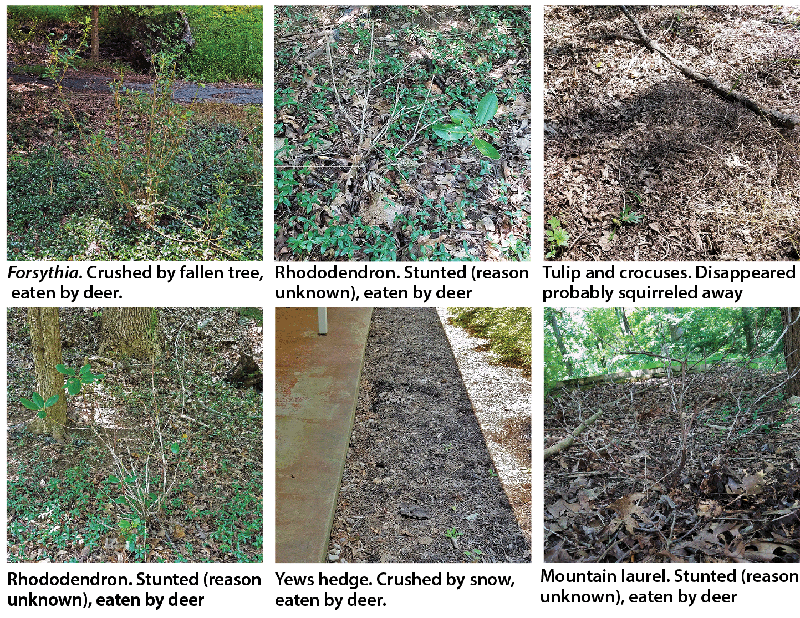
When Janet and I first moved to "the country" we still entertained that warm, fuzzy view of Nature. We had plans for improving the landscape with native and ornamental plants, and we bought fine specimens of rhododendrons, forsythia, mountain laurel, hydrangeas and a lilac. There were already azaleas, hemlocks, yews and even a tulip and a few crocuses in place, although some seemed a little worse for wear. There were a few things that I was not so keen on; malformed hollies and an overgrown boxwood led the list. (To me, boxwood smells of the ripe urine of an unaltered tom cat.) The Imp made its presence and intent known very quickly. We were caught entirely off guard; we lost before we knew an attack was underway. Here, for your consideration, are images of  those plants now.


The Lilac
Our postmortems and inquests led us to two resolutions: First, we would leave the skeletons of certain plants as a reminder to never purchase another, unless we were prepared to sacrifice significant energy and money on its behalf. (Let's just say, we haven't gotten any new plants.) Second, we would fight for one specific plant, a lilac that we had placed on one of the few flat, sunny spots on the property. This would be our line in the sand.

The Lilac
The first few years brought only minor skirmishes, including a notable episode with a mealybug infestation, eventually brought to heel with insecticidal soap. The tiny luffas were a pain, but we managed to give those little mealy jerks the ol' scrub a dub. The deer were as persistent as ever, especially during winter, when they would browse the tips of Lilac's branches. But they would occasionally get a hankerin' for a lilac salad, too. The deer challenge was met with a commercial deer repellent. This aptly named concoction uses rotten eggs as a base, with roadkill extract, diaper squeezings and ash from reputable American skunk crematoria. (Inferior formulas with cheap Chinese puppy or kitten ash should be avoided.) The repellent helped and was reapplied after rain or snowfall, or whenever the shrub started to smell good. The Imp deployed a few nose-less soldiers. Stiltgrass and dogbane constantly encroached on Lilac; we slashed them back. Honeysuckle vines slithered in to strangle her and an Ailanthus tree tried to eclipse Lilac's sunshine. We cut them and poisoned their stumps. We were merciless; we took prisoners and performed enhanced interrogations. Those that died were the lucky ones.

Despite our attentions, the lilac failed to bloom for quite some time. We weren't too concerned at first. A plant needs time to adjust to new soil. First year, sleep; second year, creep; third year, leap ... or so the folksy gardeners say. We did get one good season of blooms, before it went back to creeping. It must have been a leap year. We had resigned ourselves to accept creep as the new normal; drop a load of magic stink on Lilac in exchange for a few blossoms. That's what real winning looks like, kids.

Unfortunately, The Imp was just biding its time and chose 2017 for a series of full frontal assaults. Its first big move was to arrange one of the warmest Februarys on record, prompting the witless lilac to leaf out and develop tiny embryonic inflorescences. Then came March and a sudden return to subfreezing temperatures that threatened to nip Lilac's tender shoots. This had the potential to send us all the way back to sleep status, maybe even the big sleep. So, Lilac was wrapped in an igloo of tarps, supported by stakes and bound together with zip ties. We also used a long extension cord to energize a heated water bucket that steamed away within the igloo during frigid nights. When warmer weather returned, we disassembled the apparatus to allow a little photosynthesis. The Imp tested our resolve again by arranging yet another bout of freezing temps. We rebuilt the igloo and resolved to repeat this as long and as often as necessary.

Left: Tarp igloo built to protect Lilac from Jack Frost. Right: A few blooms that Lilac offered as a "Thank you".

Spring finally arrived and our efforts were rewarded with a few blossoms. We had held the line at creep. The Imp would have to up its game. The dreaded concoction was still deployed, but the aroma of Satan's Armpit was now laced with the sweet notes of lilac. I felt like handing out cigars.

Our success in the first major battle and the improving weather led us to a misguided sense of security, and we went back to business as usual. Then, one day in mid-August, we were strolling the grounds and making inspections. We noticed a good bit of insect activity around Lilac and drew closer to investigate. The bush seemed to swarm with gigantic wasps. They resembled yellowjackets, Vespula sp. (Vespidae), but were substantially larger. The wasps were entering and exiting Lilac's leafy vestiture in a rather steady stream, with those exiting often bumping into those arriving. They seemed to wrestle a bit in flight, before resuming their travels. I first surmised that the wasps had built a nest in or near Lilac. This wasn't particularly alarming in itself and could even be a plus if they kept the deer at bay. Having been well trained by my interactions with normal yellowjackets, however, I was a little perplexed by the wasps' seeming indifference to us.

As a log turner I search for spiders, centipedes and such things and get stung by yellowjackets once or twice every year. Every so often, I turn a log and see a lone yellowjacket at the opening to a small tunnel. The wasp seems unperturbed and, during my early years, I assumed that if I put the log back gently and walked slowly away--whistling and with my hands clasped behind by back--the wasp would forgive my trespass and give me the benefit of the doubt. However, wasps do not forgive and are apparently programmed to teach log turners a lesson, no matter what. I would stroll 10 to 20 feet away and, just when I thought I was in the clear, there would be the sensation of a sudden electric shock, usually on the back of my hands or wrists. Now when I roll a log and see a day-dreaming  yellowjacket, I run like crazy. This behavior may seem strange to onlookers, such as a cluster of entomology students, but the benefits outweigh any loss in pride.

Anyway, back at Lilac, I peered in and saw scattered clusters of giant wasps. They seemed to be ripping and chewing at the bark and exposing Lilac's innards. At the time, it seemed that this could only be motivated by pure vindictiveness. What on earth could they be doing?  I turned to Janet and told her what was happening. She sprang into action and shook one of the branches to dislodge a giant wasp. Well, the unintended experiment produced results. It seems that there is a limit to the wasp's tolerance afterall, and she got stung. She stormed to the garage to find some chemical weapons, and the break in the action allowed me to take some pictures. Janet returned with the dregs of the old insecticidal soap, which to me smelled remarkably similar to the deer repellent. It actually seemed to drive them off, at least temporarily. Janet then retreated to the pharmacopia for antihistamines and cortisone cream.


A quick search of the internet revealed that the wasps were European Hornets, Vespa crabro (Vespidae), alien relatives of yellowjackets and paper wasps. The girdling of lilacs and other woody plants is a well-known hornet behavior, sometimes explained as the collection of fiber for nest construction. But nest material is actually derived from rotting wood mixed with saliva. Thus, these things live in a kind of spittoon (Ask your grandfather.). The girdling of woody stems appears to be a mechanism to access plant sap. [See the article on the topic by blog follower Dr. Albert Green (Santamour & Green, 1984).] Otherwise, hornets are largely carnivorous, feeding on a wide variety of insects. They may even try to subdue cicadas, as shown in a video in my last post, Nature in Fragments, in which I misidentified a European hornet as a cicada killer, Sphecius speciosus (Crabronidae). [Hey. It's free, so get of my back about it!]
 
Hornet damage
That night, Janet and I were sitting in our basement discussing strategy and playing with our cats Dickens and Fuzzball. Our favorite games are catch-the-disappearing-stick and Da Bird. The Norman Rockwell moment was interrupted by a persistent tapping at the sliding-glass door. I looked and was stupefied. There were half a dozen hornets banging against the glass, as if intent on doing to us what they had been doing to Lilac. Giant night-flying wasps, really? It was like a Hitchcock movie. Janet, still stinging, charged the door to confront and slaughter them. (I suspect this was a steroidal rage fueled by excessive cortisone cream.) She opened the door, and a couple wasps got inside. Hilarity ensued. We got to experience the pleasure of dispatching a couple hornets, and additional satisfaction the following night when one was captured by a large orb-weaving spider, Neoscona crucifera (Araneidae), that had made its web in front of the same door. I thought about sitting there all night with popcorn to watch the slow-motion festivities.

Left: Night-flying European hornet trying to enter our home to strip the bark from our limbs. Center: A casualty of the hornet wars. Right: A third belligerent enters the fray.


It turns out that Vespa crabro is one of the few night-flying wasps, even though recent research has shown that their eyes are no better at seeing in the dark than day-flying wasps and may even be a little worse. At one point I entertained the possibility that the hornets had supernatural abilities, perhaps communicating in some buggy version of Aramaic or Latin. We would be needing an exorcist. However, I screwed my faith in science to the sticking place and clicked my way to the web site of the University of Maryland Extension Service for information and help. Indeed, there was a page devoted to European Hornets, and I remember it reading something like this [cue harp music]....
----------
Congratulations! You somehow identified the pest yourself as <Giant European Hornet>. This is a really big hornet from Europe. Here's a dark, grainy, off-color picture of a hornet scanned from an old EPA magic-lantern slide.

https://extension.umd.edu/hgic/european-hornets
This is the only true hornet in Maryland. Now, you laypeople may have heard of the Bald-faced "Hornet", Dolichovespula maculata (Vespidae), but it's really a black and white yellowjacket, even though it's not yellow. So, it's not a true hornet, but it is a true yellowjacket. Got it? True hornets may chomp on lilacs. They live in a group of over 100 workers and often fly around, even at night. They aren't as mean-spirited as some wasps, such as the bald-faced hornet, which, as you recall, is not a true hornet. They may nest in the walls of your home, somewhere in your barn or in a treehole out in the woods somewhere. To kill them, call an exterminator or put on your beekeeper suit and spray them during the day time. Follow the directions on the bottle of whatever poison you happen to find. Our specialists suggest some kind of insecticide for true hornets. Screw IPM and that organic crap. There are no alternatives to insecticide, even if the hornets are nesting under your kid's bed. You want to save your shrub, don't you? Don't you?   
   
Still not convinced? (Shield your eyes, Timmy!) Here's a graphic picture of a holly branch that hornets have gnawed on. Look at it. Look ...at ...it!


Well, now, isn't saving your beautiful, suffering, oxygen-rendering (and thus life-giving) shrub worth a few points off junior's IQ? You can always adopt new pets. And who really needs squirrels, anyway? Think about it. Think about it!
     Follow these links for more useful tips.
----------
Modern extension? Seemed more like future retraction. Anyway, it was clear enough...we were on our own.

 
Henry Wadsworth "Hank" Kimball. County Extension Agent.

Combing the woods for a hornet's nest that might be in a treehole 30 feet from the ground did not seem like fun to us. Nor did shooting a geyser of insecticide into the sky. We reasoned that we needed some kind of barrier akin to the igloo but which allows sun and air to get to Lilac. We found a thing called Agfabric on Amazon, bought a bunch and made a tent out of stakes and those big metal paper clips. It worked!


A few hornets got trapped inside and started screaming in Aramaic to be released, but we were incapable of pity at this point. Hornets continued to bounce impotently off the new force field. It took them days to give up entirely. We had stopped the hemorrhaging of lilac sap with hemorrhaging from our bank account.

Were we victorious? No. The Imp had won. It had never been after Lilac, its goal had always been to inflict physical, emotional and financial pain on us. The Imp has had a lot of practice and is very good at what it does. One can respect that. For the most part, our psyches have moved on, but there are parts that still huddle in a dark corner wielding a pointed stick, twitching and shivering, with all senses alert, waiting in dread for The Imp's next move.